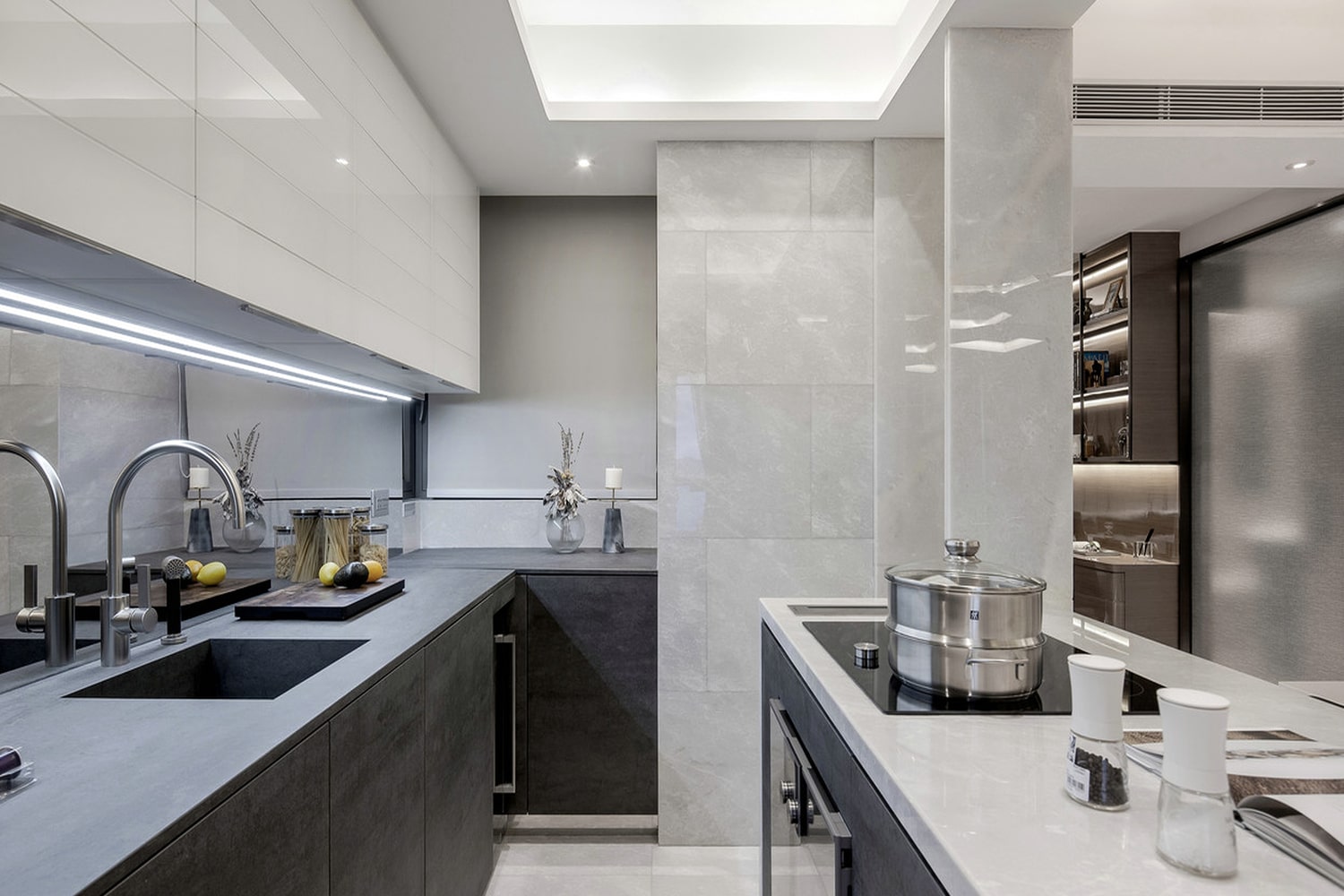
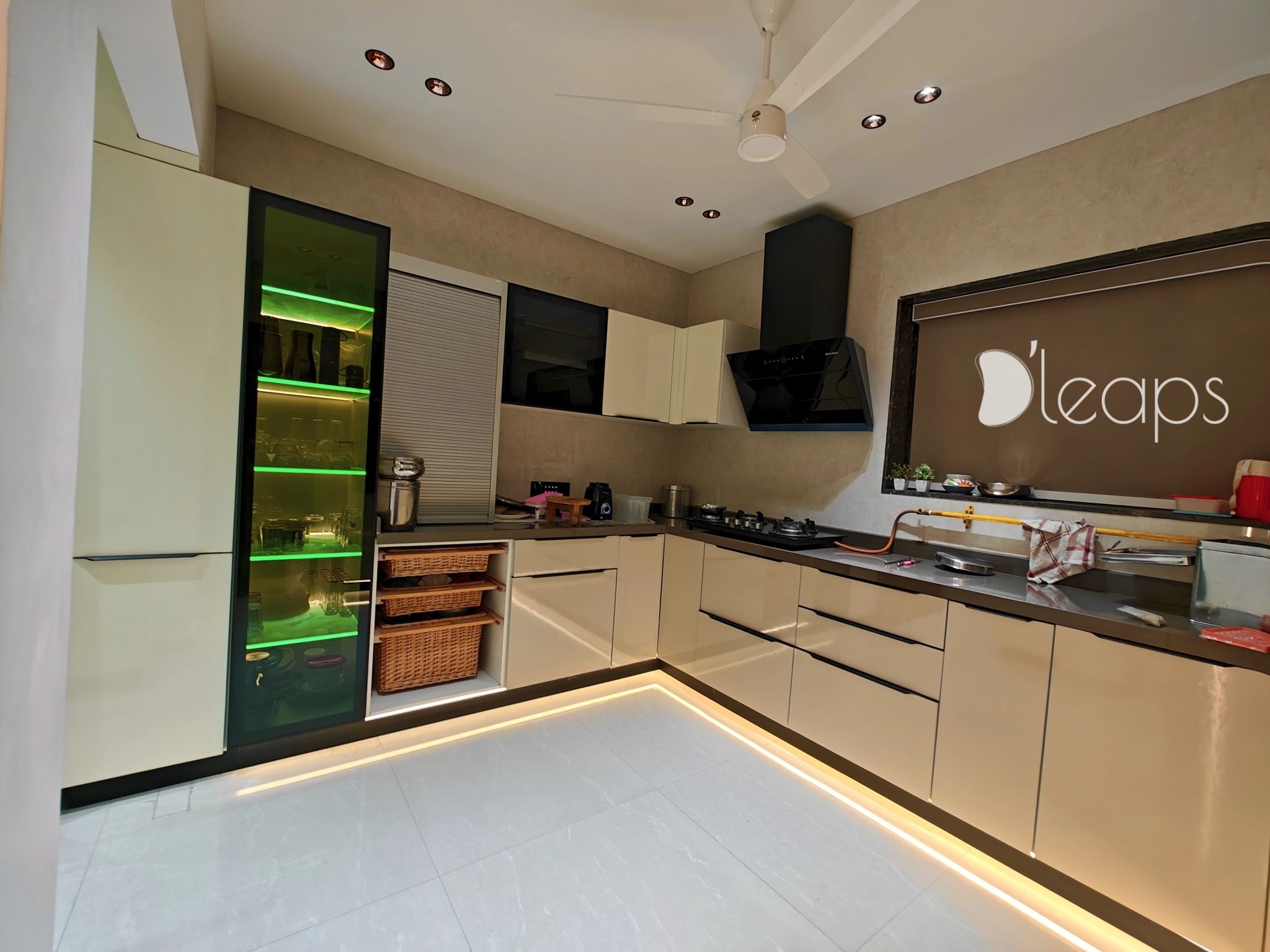
Selecting the right finish for your carpentry works isn’t just about looks — it’s about matching durability, maintenance and lifestyle with your design vision. At D’leaps Interior Design Studio, we help you understand the strengths of each surface finish, so you can make a confident choice that enhances both style and functionality in your home.
A wardrobe is one of the largest visible surfaces in any bedroom. It is touched, opened and wiped down every single day for ten years or more. So the finish you pick on those shutters decides three things at once: how the room feels, how much upkeep it demands, and how much it costs. This guide breaks down every popular wardrobe finish available in Hyderabad today — what it is, what it costs, and where it shines or struggles.
First, a quick clarification: the board vs. the finish
A common source of confusion. The board (or carcass) is the structural material — usually BWP/marine plywood, HDHMR. The finish is the decorative skin bonded on top — laminate, acrylic, membrane, PU or veneer. The same plywood box can wear any of these finishes. So when you compare “laminate vs acrylic,” you are really comparing the skin, not the structure underneath.
Everything below assumes a quality plywood or HDHMR carcass. The finish is the variable we are pricing.
Part 1 — The Laminate Family
Laminate (technically HPL, High-Pressure Laminate) is the default surfacing choice in Indian homes for good reason: hundreds of designs, strong durability and excellent value. But “laminate” is not one thing — it is a whole family of finishes at very different price points.
1. Standard Decorative Laminate (Sunmica)
The everyday workhorse. A printed decorative sheet pressed onto the board, available in solid colours, wood grains and stone looks.
- Indicative cost: ₹300–₹900 per 8×4 ft sheet (roughly ₹40–₹90 per sq ft for material). A 0.8mm sheet is the budget option; for wardrobe shutters we recommend 1mm.
- Pros: Cheapest finish, enormous design range, scratch-resistant, easy to clean, widely available across Hyderabad.
- Cons: A faint seam is always visible at panel joints; flat, slightly “matte-plastic” look on cheaper grades; edges need separate PVC edge-banding.
- Best for: Children’s rooms, guest bedrooms, rental properties, and the inner faces of every wardrobe.
2. High-Gloss Laminate
A reflective, mirror-like surface that brightens and visually enlarges a room — the budget route to a glossy modern look.
- Indicative cost: ₹900–₹1,800 per sheet (around ₹55–₹120 per sq ft material).
- Pros: Premium sheen at a fraction of acrylic’s price; makes compact rooms feel larger; bold colour options.
- Cons: Shows fingerprints, dust and smudges readily; minor scratches catch the light; needs frequent wiping to stay sharp.
- Best for: Adults’ master wardrobes where the owner is happy to wipe down regularly.
3. Matte / Suede Laminate
A soft, non-reflective, velvety surface. This is the dominant 2026 aesthetic in Hyderabad’s premium homes.
- Indicative cost: ₹800–₹1,500 per sheet.
- Pros: Sophisticated, understated look; hides fingerprints and minor smudges far better than gloss; very forgiving on large shutters.
- Cons: Stubborn stains can be slightly harder to scrub off than gloss; premium suede grades cost more than standard laminate.
- Best for: Master bedrooms, contemporary and minimal interiors, anyone who hates the daily wipe-down.
4. Textured & Wood-Grain Laminate
Laminates with a physical texture you can feel — synchronised wood grain, leather, fabric or stone textures that read as genuine material.
- Indicative cost: ₹150–₹300 per sq ft material (premium “synchro” wood textures sit at the top of this band).
- Pros: Realistic tactile feel, warmth of wood without veneer’s price or upkeep, hides scratches well.
- Cons: Pricier than flat laminate; textured surfaces can trap dust in the grooves.
- Best for: Clients who want a natural, warm look on a controlled budget.
5. Fluted / 3D Laminate Panels
Ribbed, vertical-groove panels used as a feature on a single shutter or a wardrobe end-panel. A strong current trend.
- Indicative cost: Priced per panel; budget a premium over flat laminate for the material plus extra labour.
- Pros: High-impact, architectural feature; adds depth and texture; great accent without redoing the whole wardrobe.
- Cons: Grooves collect dust and need careful cleaning; works best as an accent, not the entire wardrobe.
- Best for: A statement wall or one feature shutter.
6. Digital / Customised Laminate
Fully custom printed designs — murals, patterns, brand artwork or a photograph — printed to order.
- Indicative cost: ₹800–₹1,500+ per 8×4 ft sheet depending on artwork.
- Pros: Total design freedom; unique, personalised result.
- Cons: Premium pricing; the design is permanent, so trend-led prints can date.
- Best for: Kids’ rooms, theme-based interiors, signature feature pieces.
7. Acrylic Laminate (PMMA)
A 1mm acrylic sheet that delivers a deep, glass-like, seamless high-gloss surface — the most luxurious member of the laminate family. Often discussed as its own finish (see Part 2).
- Indicative cost: ₹2,300–₹5,500 per sheet (anti-scratch grades at the top end).
- Pros: Stunning mirror-like depth; no visible seam; excellent colour retention for 8+ years.
- Cons: Among the costliest skins; high-gloss versions show every fingerprint; repairs mean replacing the whole shutter.
- Best for: Showpiece master wardrobes where the visual is the priority.
Part 2 — Beyond Laminate: The Premium Finishes
Once you move past laminate, you enter “seamless finish” territory — surfaces that wrap edges or hide joints entirely. These cost more but deliver a continuous, high-end look laminate cannot match.
Membrane (PVC Foil)
A thin PVC foil vacuum-pressed over an MDF shutter so it wraps every edge and groove in one continuous skin — no edge-banding required.
- Relative cost: Mid-range — above laminate, well below acrylic and PU.
- Pros: Seamless one-piece look; flows beautifully over routed designs and curved/soft edges; good water resistance; low maintenance (a damp cloth is enough).
- Cons: Can lift or peel near sustained heat or steam over time; limited high-gloss depth versus acrylic.
- Best for: Wardrobes with routed/grooved shutter designs and homeowners wanting a clean look on a moderate budget.
Acrylic
A high-gloss acrylic sheet bonded to the board for a flawless, reflective, factory-finished surface — the showroom look.
- Relative cost: Premium — typically 2–3× the cost of an equivalent laminate finish.
- Pros: The most striking modern look; deep mirror shine; bold colours; holds appearance and colour for years, even in humid conditions.
- Cons: Shows fingerprints and dust; needs regular wiping; damaged panels are replaced, not patched.
- Best for: Premium, design-forward master bedrooms.
PU (Polyurethane Paint / Duco)
Multiple coats of polyurethane paint sprayed and cured over an MDF/HDHMR shutter, finished in matte, satin or gloss. The most bespoke finish available.
- Relative cost: The most expensive of the common finishes.
- Pros: Any RAL/Pantone colour you want — total colour freedom; perfectly smooth, seamless, uniform; arguably the most premium feel; minor scratches can be touched up.
- Cons: Highest cost; chips on hard impact and chips are hard to colour-match later; quality depends entirely on the painter’s skill; can soften slightly under extreme heat.
- Best for: Luxury interiors and accent shutters where colour precision matters most.
Veneer
A thin slice of real wood bonded to the board — genuine grain, genuine warmth, finished with a protective top coat.
- Relative cost: Premium, comparable to acrylic depending on the wood species.
- Pros: Authentic natural wood character; every sheet is unique; ages with a rich patina; timeless, never looks “synthetic.”
- Cons: Needs periodic polishing/maintenance; can warp or react in very dry or very humid conditions if not sealed well; pricier and less stain-tolerant than laminate.
- Best for: Warm, classic or premium-natural interiors for clients willing to maintain it.
Lacquered Glass
A coloured, back-painted toughened glass shutter for an ultra-glossy, fully wipeable, luxury statement.
- Relative cost: Top-tier premium.
- Pros: Striking depth and shine; completely seamless and easy to clean; moisture-proof.
- Cons: Heavy (needs strong hardware); expensive; edges and corners need care; not ideal for high-impact zones.
- Best for: Luxury, statement wardrobes.
Budget Comparison at a Glance
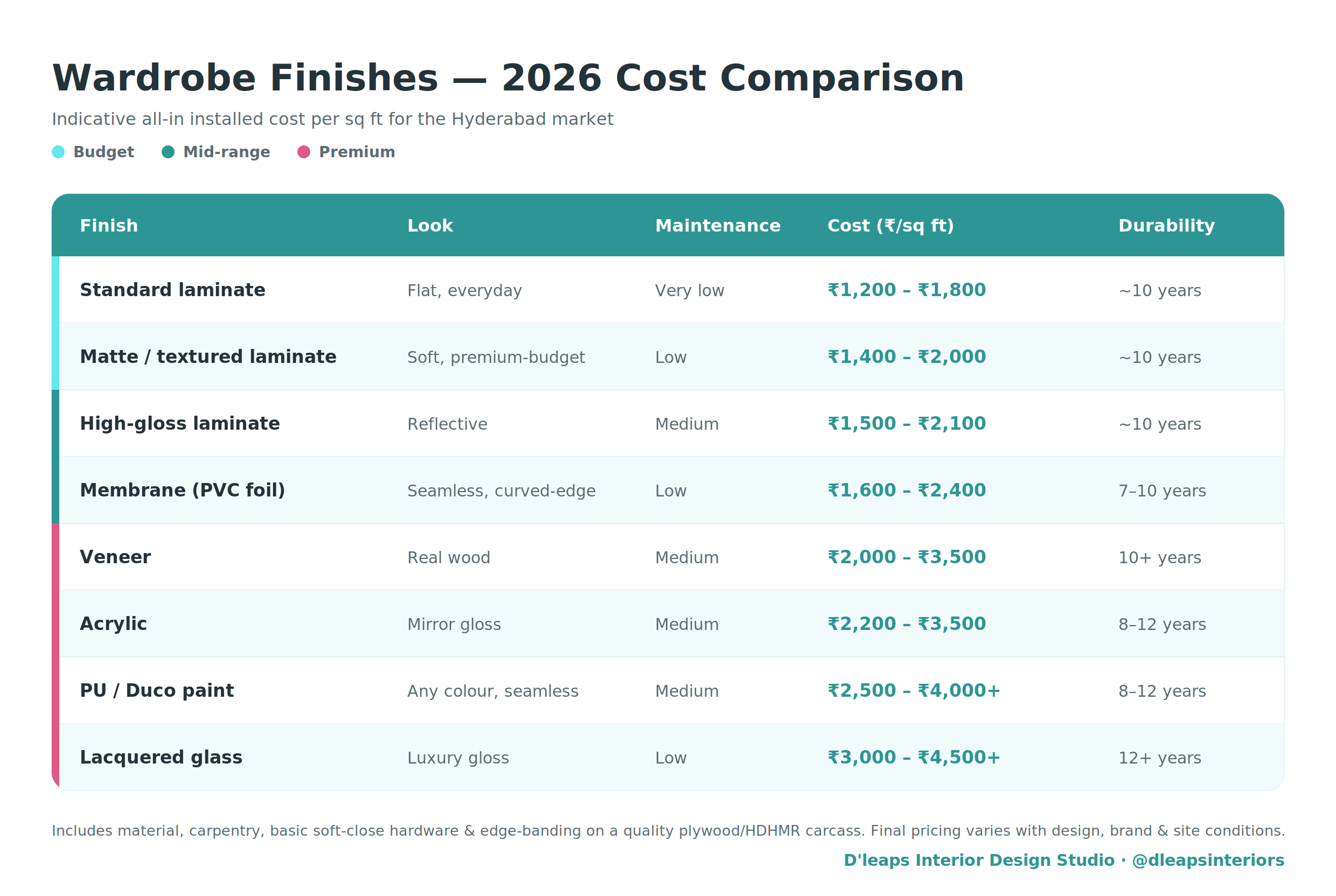
The most useful number for planning is the all-in installed cost per sq ft — material plus carpentry, hardware and edge-banding — for a wardrobe on a quality plywood carcass. These are indicative 2026 ranges for the Hyderabad market and shift with brand, design complexity, sliding vs hinged shutters, and hardware (Hettich/Hafele/Ebco) choices.
How to Choose: A Hyderabad-Specific Lens
The “best” finish is the one that fits your life and your climate, not the most expensive one on the list.
- Match the finish to the room’s user. Kids’ and guest wardrobes rarely justify acrylic or PU — durable matte laminate is smarter money. Save the premium finishes for the master bedroom where they are seen and appreciated daily.
- Respect Telangana’s climate. Hyderabad runs hot and, through the monsoon, humid. Laminate and acrylic handle heat and humidity with ease. Veneer and PU are more sensitive — they perform beautifully but reward careful sealing and a stable indoor environment.
- Be honest about maintenance. If a daily wipe-down sounds exhausting, skip high-gloss and go matte. Gloss surfaces look spectacular in the showroom and show every fingerprint at home.
- Mix finishes to stretch the budget. A favourite D’leaps strategy: premium acrylic or PU on the visible front shutters, matching matte laminate on the inner faces and tall side panels nobody studies up close. The result reads as a fully premium wardrobe while trimming 15–25% off an all-premium quote — a difference most people genuinely cannot spot.
- Don’t forget the carcass. A premium finish over a weak board is a false economy. In humid cities, BWP plywood or HDHMR under the finish is what makes the wardrobe last.
The D’leaps Approach
There is no single “right” finish — only the right finish for your space, your habits and your budget. Our job is to translate your design vision into a specification that still looks beautiful and works flawlessly ten years from now. We walk you through samples, weigh the trade-offs honestly, and build a finish plan that respects both your aesthetic and your wallet.
Planning a new wardrobe or a bedroom makeover? Reach out to D’leaps Interior Design Studio and let’s choose a finish that’s confident, practical and unmistakably yours.
📍 D’leaps Interior Design Studio — L.B. Nagar, Hyderabad · Tirupati 📸 @dleapsinteriors